
Physical coordinates
Components live in real micrometers, not abstract grid tiles — geometry is true from the first placement.
Lunima is the open photonic design workspace you can download and use today. Generative placement and agentic design are the physics-informed ML directions we're building on top of it — in development, not yet shipped.
Lunima is the open-source engine at the core of Lampsi Labs: physical layout, PDK-aware components, explicit waveguide routing, hierarchy, simulation-aware loss, and exports — all in one editable model you sit in and design.
The Lunima workspace — placing components, routing waveguides, and running a power-flow simulation.
A photonic die does not forgive bad geometry. Lunima routes waveguides as real S-bend and Manhattan paths between pins. One click of a button allows you to see the surfaces transmission and loss from the actual geometry.
Routed paths, not abstract nets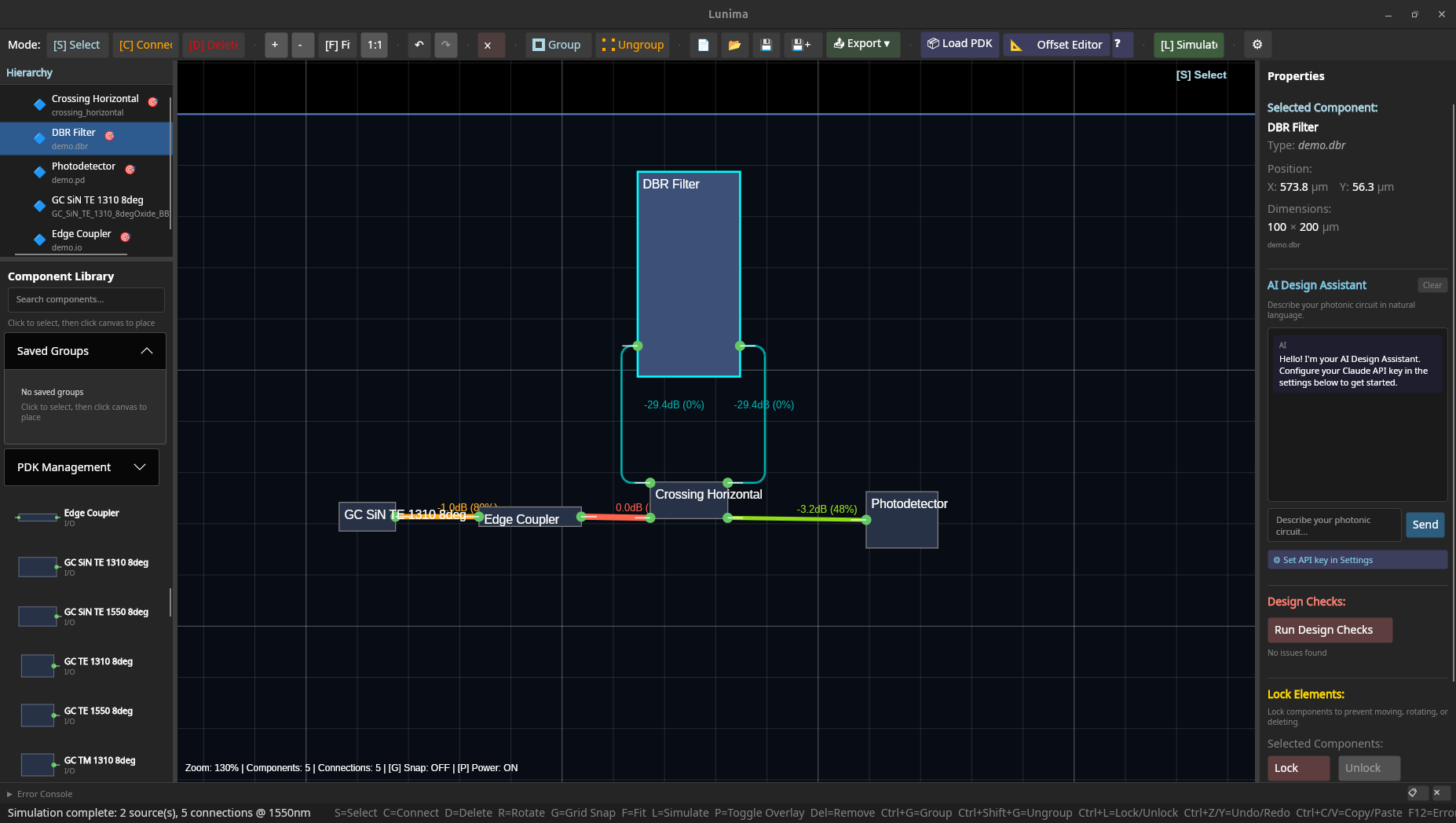
Work from PDK component libraries — splitters, couplers, phase shifters, grating couplers, detectors — each carrying physical pin positions and S-matrix data. Drop them onto the canvas and they behave like the parts they represent.
PDK-backed component library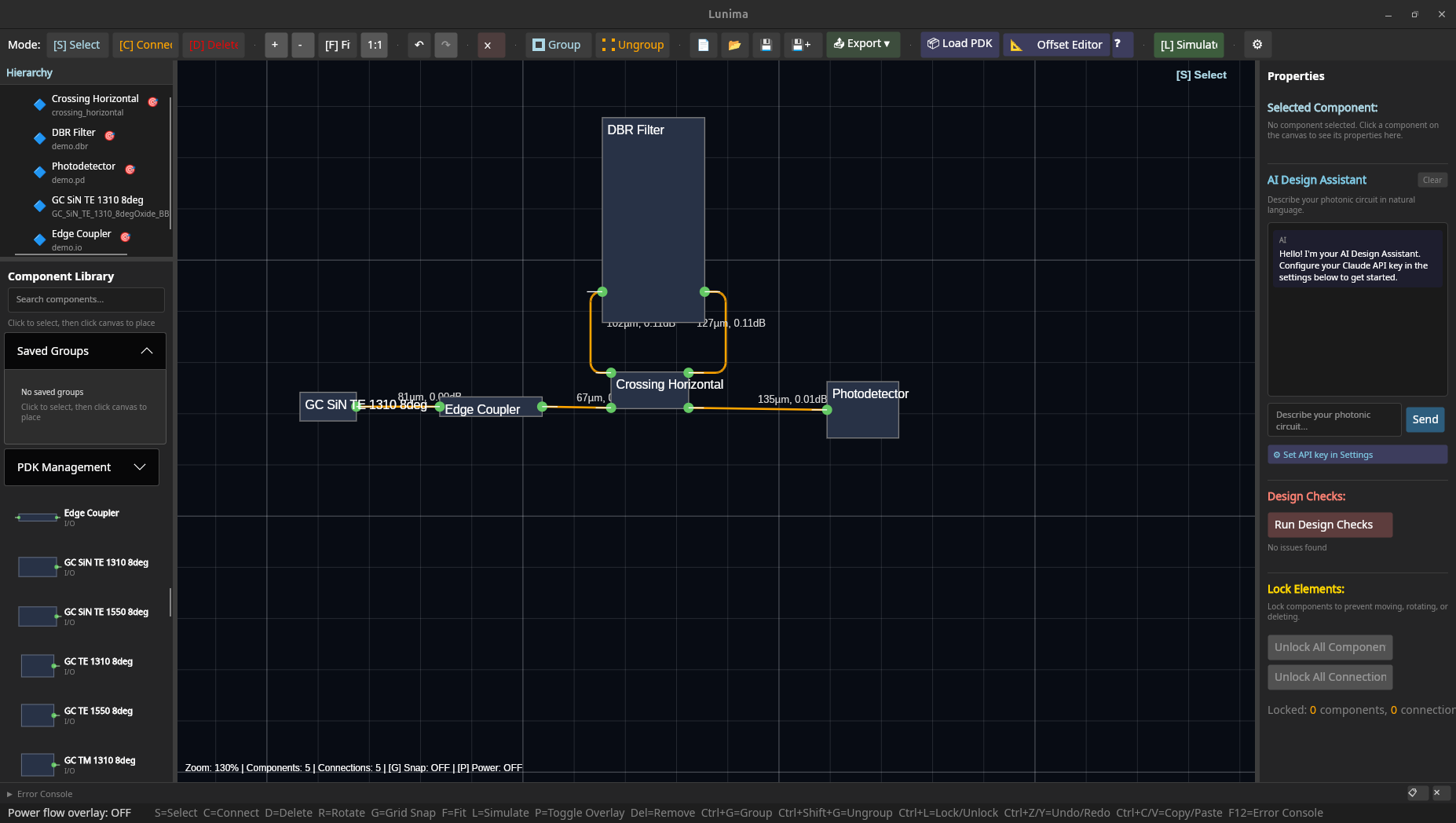
Export a single layout to the formats your team already runs — Nazca Python + GDS for fabrication, SAX/Simphony for circuit simulation, PhotonTorch for time-domain GPU runs, and Verilog-A/SPICE for co-simulation with electronics.
Nazca · GDS · SAX · PhotonTorch · Verilog-AComponents live in real micrometers, not abstract grid tiles — geometry is true from the first placement.
Waveguides are routed as S-bend and Manhattan paths between real pins, not drawn as abstract nets.
Build reusable subcircuits with external pins and frozen layouts, then compose larger systems.
Component libraries carry physical pins and S-matrix data, so parts behave like the devices they represent.
Transmission and loss derive from the actual path geometry, keeping design intent tied to physics.
Built on the open Lunima engine, with Nazca export to hand off to the fab flow you already run.
An in-house, physics-informed generative model that places photonic components at scale. Given a set of components and the connections they need, it proposes arrangements on the physical canvas — routing-aware layout exploration that respects the physical difficulty of routing waveguides through dense systems.
“Physics-informed” is not decoration: in photonics, where you place a component largely decides whether it can be connected at acceptable loss. The model is meant to reason about routing feasibility and loss while it places, not after — and because proposals write into the same grounded model, a suggested layout can be inspected, routed, and simulated like any other design.
This is in development and not yet available. Nothing here is something you can do in the workspace today; it describes the direction Lampsi Labs is building toward.
Read the full vision →The direction we're building toward: an agent that takes human-language intent — what a circuit should do — and drives the photonic design forward, from natural language toward tapeout.
It builds on the same idea that grounds the rest of the workspace — working over structured circuit state, not a disconnected prompt — so intent stays tied to a real, checkable design rather than a picture that has to be redrawn.
This is an early direction, not a shipped feature. We're describing where we want to take photonic design — there is no availability, and we are not putting specifics or dates on it yet.